
7 Best Telegram Channel Discovery Platforms for 2026

Last updated: October 2026
The best Telegram channel discovery platforms are the app's native search, third-party directories like TGStat, and specialized search engines such as Semagram. A Telegram channel discovery platform is a tool designed to help users find public channels. Unlike Telegram's basic search, these platforms offer advanced filters, analytics, and content-based searching to uncover relevant channels beyond just popular ones.
Finding relevant channels requires more than a single search. Most discovery happens outside the app, using platforms that index channel data, track performance, and analyze content. This guide evaluates 7 methods based on index size, data accuracy, and cost, helping channel operators and marketers find partners, research markets, or source content effectively.
How We Evaluated These Platforms
Choosing a Telegram channel discovery platform depends on the goal. We assessed these tools against four practical criteria for channel operators and marketers:
- Index Size & Freshness: How many channels does the platform track? How quickly does it update new data like subscriber counts and posts?
- Data Granularity: Does it provide basic listings or deep analytics like engagement rates, audience overlap, and mention tracking?
- Usability & Interface: Is the tool a simple search bar or a complex analytics dashboard? Is it accessible via web, app, or bot?
- Cost & Model: Is it free, freemium, or a paid subscription? What limitations apply to free tiers?
Telegram Channel Discovery Platforms: A Comparison
| Platform | Best For | Price Model | Key Limitation |
|---|---|---|---|
| 1. Telegram Native Search | Quick searches for popular channels | Free | Results are shallow and biased towards high subscriber counts. |
| 2. TGStat | Deep analytics and historical data | Freemium | Data can have a slight lag; smaller channels may be missing. |
| 3. Telemetr.io | Vetting channels for ad buys | Freemium | Interface is complex; historically stronger in CIS markets. |
| 4. Google Search Operators | Finding channels with a web presence | Free | High noise-to-signal ratio; requires manual filtering. |
| 5. Semantic Search Engines | Discovering channels by content topic | Freemium | Smaller index size; results can be abstract. |
| 6. Curated Lists & Directories | Niche-specific channel discovery | Free | Quality is inconsistent; many lists are outdated. |
| 7. TeleRanks Search Ranking | Getting your own channel discovered | Paid Service | Not a discovery tool for finding other channels. |
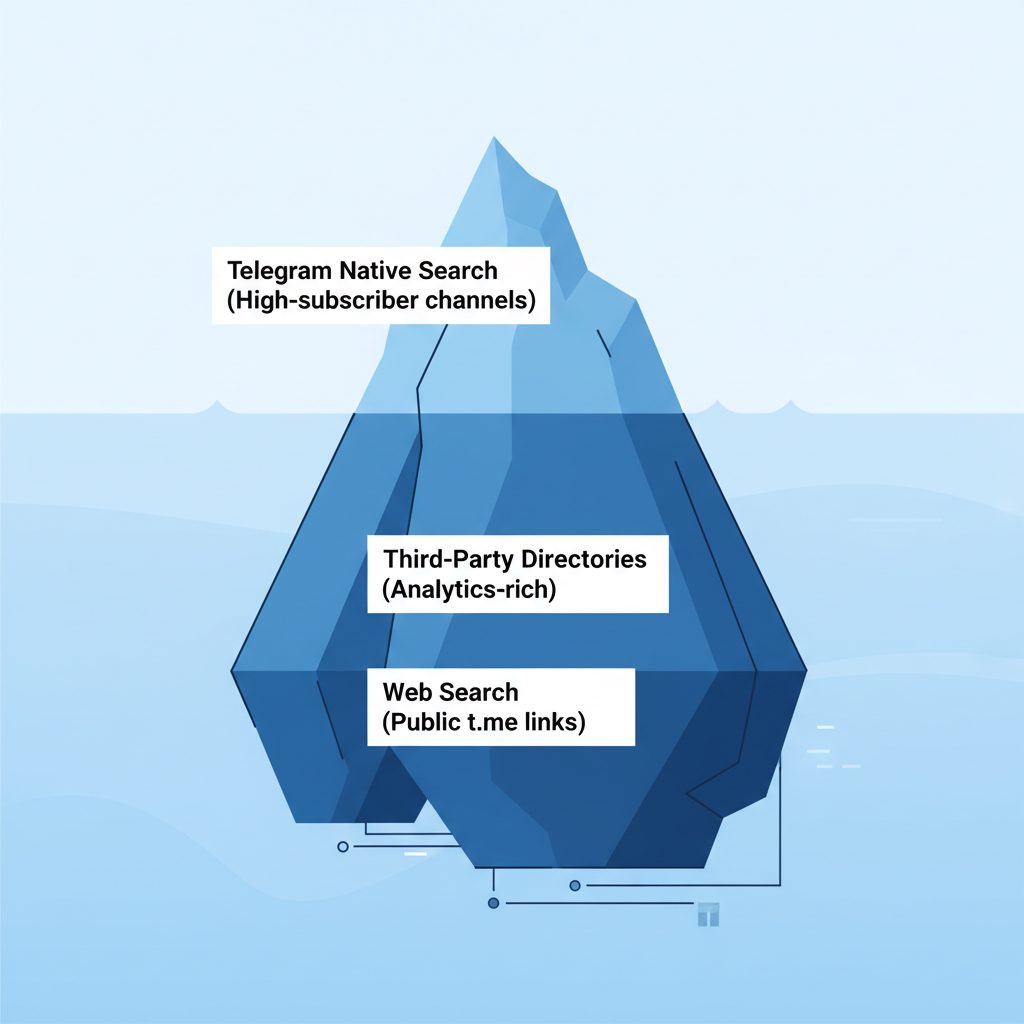
7 Platforms for Telegram Channel Discovery
No single platform is a complete solution. The most effective approach combines the speed of native search with the depth of third-party analytics. Here is a breakdown of seven methods.
1. Telegram Native Search
Telegram's built-in search bar is the most accessible starting point. When you type a keyword, it returns a list of public channels, groups, and bots whose titles or usernames (@username) match the query. Telegram's algorithm prioritizes channels with higher subscriber counts, so popular, established channels appear first.
- Best for: Quick, topic-based searches where you expect to find a well-known channel.
- Price: Free.
- Limitation: It is not an effective tool for finding new or niche channels. Because it only matches titles and usernames, it misses countless channels that discuss a topic without having the keyword in their name. For a deeper dive on this, see our guide on how to make your Telegram channel searchable.
Telegram's native search is a popularity contest; it's designed to find what's already big, not what's new or niche.
2. TGStat
TGStat is one of the largest third-party Telegram analytics platforms. Its directory includes analytics for more than 2 million Telegram channels and chats. Users can search by keyword, category, or language and then analyze performance metrics like subscriber growth, engagement rate (ERR), and mentions. These statistics are unavailable within the Telegram app.
- Best for: In-depth channel vetting, competitor analysis, and market research.
- Price: Freemium. Basic search and channel statistics are free. Advanced features like audience overlap analysis require a paid subscription.
- Limitation: While its index is massive, it is not exhaustive. Data updates can lag by several hours to a day, and the platform requires channels to have a certain level of activity to be tracked.
3. Telemetr.io
Telemetr.io is another major analytics platform with a strong focus on the advertising market. Like TGStat, it offers detailed channel analytics but adds tools tailored for media buyers. These include tracking ad post effectiveness, identifying networks of channels owned by the same administrator, and analyzing ad creatives.
- Best for: Vetting channels for paid promotions and tracking advertising campaign performance.
- Price: Freemium. Paid plans that unlock the full suite of advertising tools are available, starting with a 'Pro' tier.
- Limitation: The platform's interface is dense and can be overwhelming for beginners. While its international database has expanded, its historical strength and most comprehensive data are for channels in the CIS region.
4. Google (with Search Operators)
Using Google to find Telegram channels is an indirect but powerful method. By using specific search operators, you can find public t.me links that Google has indexed. The most common operator is site:t.me [keyword], which restricts results to pages on Telegram's domain.
- Best for: Finding channels mentioned in articles, forums, or on websites outside of Telegram.
- Price: Free.
- Limitation: This method's effectiveness depends on a channel's link being shared and indexed on the public web. It produces a lot of noise, including links to user profiles and individual posts, requiring significant manual filtering. For more detail on search operators, see Google's official documentation on refining web searches.
A search like
site:t.me "fintech news"on Google will surface public channels and groups where that exact phrase has been shared. This technique uncovers channels that directory-based platforms might miss, especially if the channel is promoted on niche blogs or community sites.
5. Semantic Search Engines (e.g., Semagram)
Semantic search engines represent a newer approach to discovery. Instead of matching exact keywords, tools like Semagram search for channels based on the meaning of the content within their posts. For example, a search for "AI model efficiency" might find a channel that discusses "optimizing neural network performance" even if it never uses the exact search phrase. This allows for concept-based discovery.
- Best for: Discovering relevant channels based on the topics they discuss, rather than just their name or description.
- Price: Typically free or freemium.
- Limitation: These platforms generally have a smaller index of channels compared to giants like TGStat. The semantic algorithms can sometimes produce results that are only tangentially related to the query, as the interpretation of "meaning" can be broad.
6. Community-Curated Lists and Directories
Before large automated directories existed, discovery happened through manually compiled lists. These still exist on platforms like GitHub, niche blogs, and even within dedicated Telegram channels that act as indexes. People often organize these lists by very specific topics, languages, or interest groups.
- Best for: Finding channels in highly specific, long-tail niches that automated crawlers might overlook.
- Price: Free.
- Limitation: Quality control is inconsistent. Many of these lists are outdated, full of broken links, or heavily biased. Always verify channels from these sources on an analytics platform before engaging with them.
How Does TeleRanks Help with Discovery?
TeleRanks offers a different kind of tool. Our Telegram Search Ranking service is not a platform for you to find other channels. Instead, it is designed for channel owners who want to be discovered by others through Telegram's native search. It is a service to improve your own channel's visibility.
We use a combination of keyword optimization and targeted signals to help your channel rank higher for specific search terms within Telegram. This service is for operators who have already identified their target audience and keywords and want to capture organic traffic directly.
If your goal is broad market research or finding channels to partner with, a directory like TGStat is a better starting point. If your goal is to get found, our Telegram SEO services are built for that.
A Simple First-Week Plan
To put these platforms into practice, follow a structured approach.
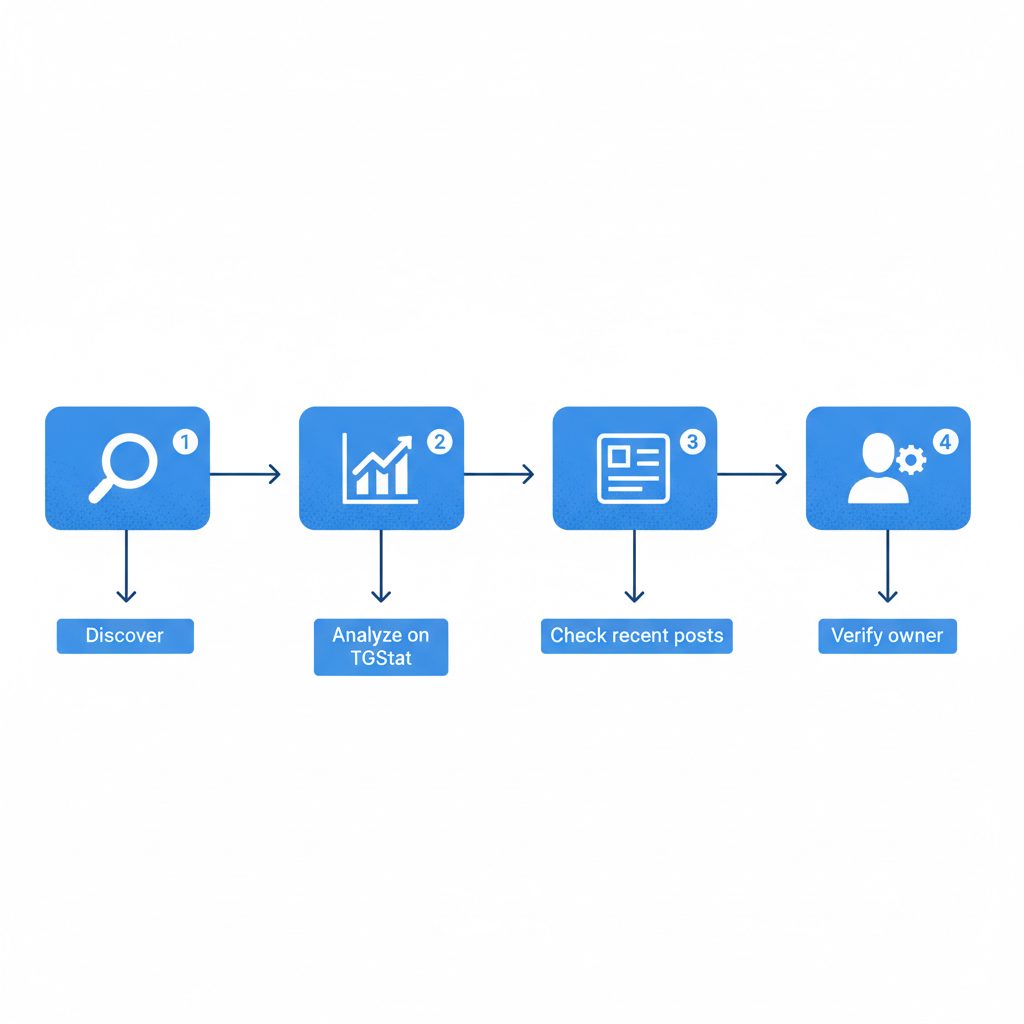
- Day 1: Brainstorm and Native Search. Identify 5-10 core keywords for your niche. Use Telegram's native search for each to map out the top-ranking, high-subscriber channels. This is your baseline.
- Days 2-3: Deep Dive with Analytics. Take the top 20 channels from your native search and look them up on TGStat. Analyze their subscriber growth, engagement rate, and mentions. Note which channels are growing steadily versus those that are stagnant or using bots.
- Day 4: Expand with Web Search. Use Google search operators like
site:t.me "your keyword"andinurl:t.me/s/ "your keyword"to find channels promoted on external websites. Add promising finds to your list. - Day 5: Explore by Content. Use a semantic search tool to search for concepts related to your niche. This may uncover channels that your keyword-based searches missed.
- Days 6-7: Consolidate and Optimize. Review your master list of discovered channels. Identify the content formats, promotion strategies, and engagement tactics that work. Use this intelligence to refine your own channel's strategy and improve its searchability. If you find your channel isn't appearing, review the common reasons why a Telegram channel is not showing in search.
Frequently Asked Questions
How do I find a specific person's Telegram channel?
If you know their username, you can search for it directly in Telegram. If not, try searching their name on Google with site:t.me (e.g., site:t.me "John Doe"). Many users link their channel from their social media profiles (LinkedIn, X/Twitter), so checking those is another effective method.
Can I search the content of all Telegram channels?
No. You can only search the content of channels you have already joined. Third-party platforms like TGStat or semantic search engines index the content of many public channels, allowing you to search across their database, but this does not cover all channels and excludes private ones entirely.
Are there search engines for private Telegram channels?
No, not legitimate ones. Private channels are private by design and are not indexed by any public search engine or directory. Access requires an invite link. Any service claiming to search or provide access to private channels is likely a scam or a violation of Telegram's terms of service and poses a security risk.
What is the best Telegram channel list directory?
For data depth, TGStat is the leading directory due to its vast index and detailed analytics. For niche discovery, community-curated lists on GitHub or niche blogs can sometimes be more effective, but they require manual vetting. There is no single "best" directory; the right choice depends on whether you need analytics or niche specificity.
How can I improve my own channel's discovery?
To improve your channel's rank in Telegram search, focus on keyword optimization in your channel's name, username, and description. Building a consistent posting history and a healthy subscriber base also contributes. Services like our Telegram Search Ranking are designed to accelerate this process by applying targeted SEO techniques.