
Telegram Global Search: How It Works & How to Rank in 2026

Last updated: October 2026
To use Telegram global search, tap the search icon on the app's main screen and enter your query. Telegram global search is the platform's internal discovery tool for finding public channels, groups, and posts based on keywords, user location, and language. It then shows matching results.
Unlike Google, Telegram's search is not a single, universal engine. It is a personalized discovery tool. It heavily weighs your location, language, and contacts when showing results for public channels, groups, and posts.
For channel owners, understanding these mechanics is the first step to gaining visibility. Mastering it requires optimizing your channel's name, public handle, and description. You also need to build enough authority to outrank competitors.
Telegram Global Search: The platform's built-in feature that allows users to find public channels, groups, bots, and posts. It uses keyword matching and personalization signals like location and language to rank results. Why it matters: For channel owners, appearing high in global search is the primary method for organic member growth, placing your content directly in front of users actively seeking it.
Key Takeaways
- Understand that Telegram's global search is personalized, not universal; results vary significantly based on user location and language.
- Optimize your channel's title, username (
@handle), and description with relevant keywords to match user queries. - Build subscriber count and maintain consistent engagement to signal authority and relevance to the search algorithm.
- Use third-party search engines like Lyzem or Telegago for complete open-source intelligence (OSINT) and historical data analysis.
- Fix your channel's basic SEO before investing in services designed to boost ranking signals for competitive keywords.
How Does Telegram's Global Search Algorithm Actually Work?
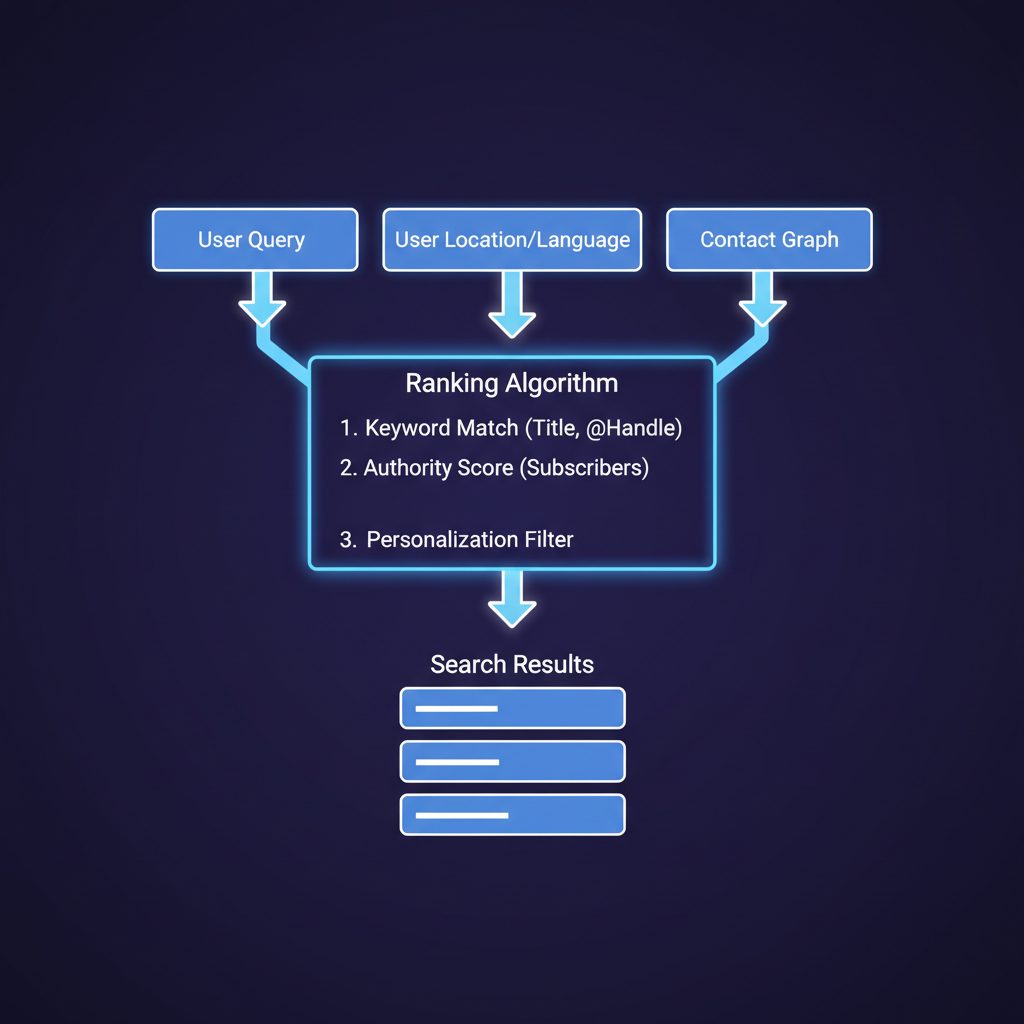
Telegram's search function operates on two levels: a private search within your own chats and a public, global search for discovering new content. The global search is what matters for channel growth. It functions like a simple search engine, relying on a few core ranking signals to order results.
The algorithm primarily ranks entities like channels, groups, and bots based on direct keyword matches and authority signals. When a user types a query, Telegram's system looks for matches in these key areas:
- Channel Title: This is the most heavily weighted factor. A channel titled "Crypto Trading Signals" has a strong advantage for the query "crypto trading."
- Public Username (@handle): The unique
@usernameis the second most important field. A memorable and keyword-rich handle reinforces the channel's topic. - Channel Description: Keywords in the description have less weight but help the algorithm understand the channel's context and surface it for long-tail searches.
- Subscriber Count: This is the primary measure of authority. A channel with more subscribers will generally outrank a similar channel with fewer subscribers.
- Personalization: Search results are not the same for everyone. The algorithm personalizes its output based on the user's country, device language, and proximity to the user's contacts.
Later, Telegram expanded search to include the content of public posts via a dedicated 'Posts' tab. This allows users to find specific messages across all public channels.
3h 57m: The average time an Android user spends on the Telegram app each month., DataReportal, 2024
What Are the Limitations of Native Telegram Search?
While powerful, Telegram's native search is not a complete web search engine. Operators must understand its limits to set realistic growth expectations.
First, the geographic and language bias is significant. A user in Germany searching for "cars" will see a different set of channels than a user in the United States. The algorithm prioritizes local and linguistically relevant results.
Second, the main discovery tool is still based on channel and group metadata (title, handle), not post content. While the 'Posts' tab exists, most users discover new channels through the main 'Chats' tab in search, which ranks channels and groups. This is why optimizing your channel's SEO basics is so important.
Third, new channels often face a "sandbox" period. A channel with few subscribers may not appear in search results, even when searching for its exact title. This is a common issue that often requires a few hundred subscribers before the channel becomes consistently visible. If you are facing this, you may need to investigate why your Telegram channel is not showing in search.
Finally, search results exclude private content and may omit channels restricted for policy violations. These restrictions can be country-specific, meaning a channel visible in one region may be hidden in another.
Comparing In-App Search vs. Third-Party Search Engines
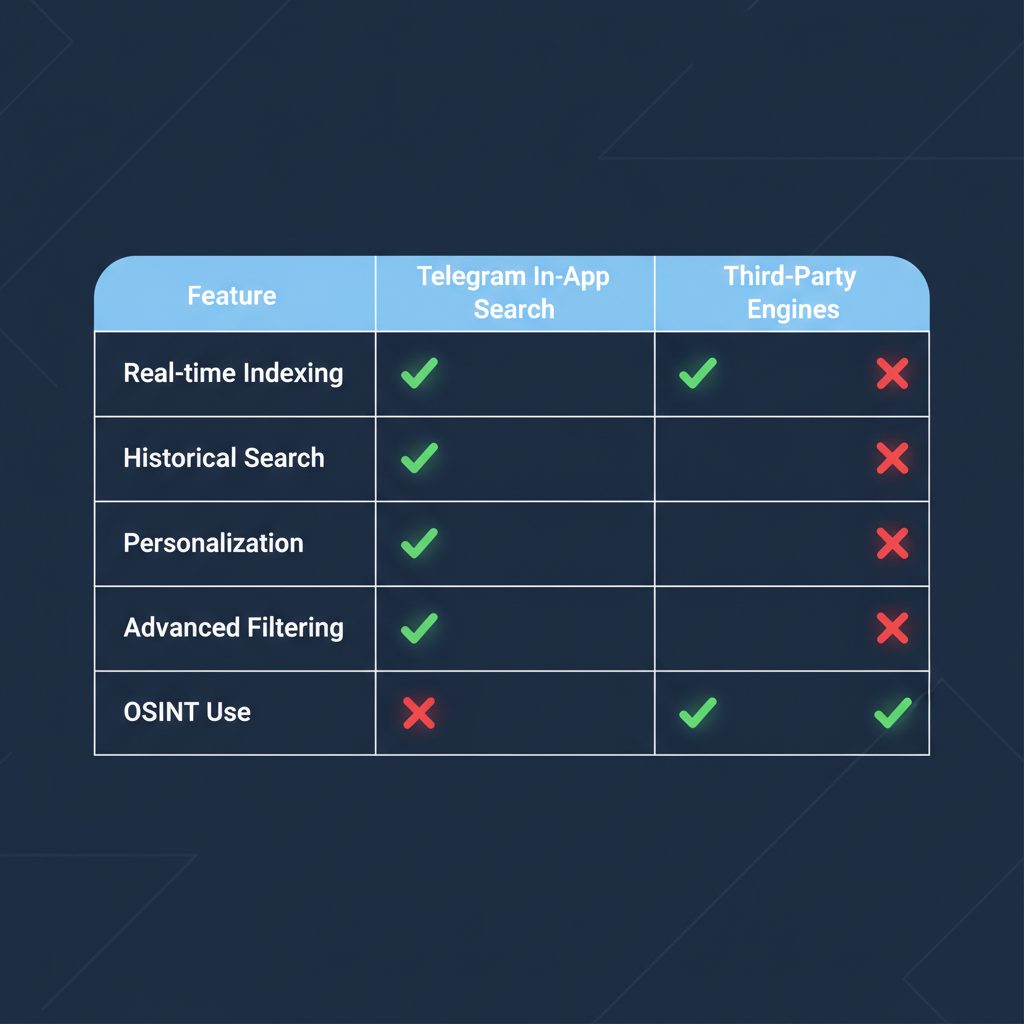
For users and researchers who find the native search too restrictive, several third-party search engines have emerged. These tools scrape and index public Telegram content, offering a different discovery experience. Understanding the trade-offs is key.
| Feature | Telegram In-App Search | Third-Party Search Engines (e.g., Telegago) |
|---|---|---|
| Index Scope | Public channels, groups, bots, and posts. Personalized results. | Scraped public channels and messages. Broader, non-personalized index. |
| Data Freshness | Real-time. | Can be delayed; relies on scraping intervals. |
| Search Filters | Basic (Chats, Media, Links, Posts). | Often advanced (date ranges, message type, language). |
| Best for | Everyday user discovery. | Open-source intelligence (OSINT), research, market analysis. |
| Privacy | Integrated into the app; your searches are known to Telegram. | External websites; no direct link to your Telegram account. |
| Ranking Factors | Authority (subscribers) and personalization. | Keyword relevance and date; less emphasis on authority. |
Tools like Telegago, a Google Custom Search Engine created by the investigative journalism group Bellingcat, are built specifically for deep archive searching, a task for which Telegram's native search is ill-suited.
Third-party tools excel at finding specific messages or analyzing trends across many channels. However, for a channel owner focused on attracting new members, ranking high in the native, in-app search is far more valuable. It places your channel directly in front of users actively looking for new communities. For a deeper look at these tools, see our analysis of the best Telegram channel finders.
Where TeleRanks Fits for Telegram Search Ranking
Optimizing your channel's title and description is the first step. For competitive keywords, however, it is often not enough to rank on the first page of results. This is where a targeted service can be effective.
The Telegram Search Ranking service from TeleRanks is designed to improve a channel's or group's position in global search for specific keywords. The service works by automatically boosting the core authority signals that Telegram's algorithm values most, primarily those related to a channel's apparent popularity and subscriber base.
This service is not a content management or promotion tool. It is for channel operators who have already implemented basic SEO but are stuck behind larger, more established channels. It helps bridge the authority gap, making it possible to compete for valuable, high-traffic keywords.
Who should choose another route? Operators whose channels are brand new, have no content, or have not yet optimized their title and username should focus on those fundamentals first. A ranking service amplifies existing assets; it cannot build them from scratch.
Checklist: Optimizing for Telegram Global Search
Follow these steps to ensure your channel is properly configured for discovery in Telegram global search.
- Audit Keywords: Identify one primary keyword for your channel title. Select two or three secondary keywords for your channel's description to capture related search queries.
- Optimize Public Profile: Ensure your channel is set to 'Public'. Your public link, or username, should be simple, memorable, and ideally reflect your primary keyword.
- Verify Indexing: From a separate account, search for your channel's exact title or username. If it does not appear, it may be sandboxed or have other visibility issues.
- Build an Authority Baseline: A channel needs a base number of subscribers (typically 200+) to be taken seriously by the algorithm. This initial push can come from existing audiences or promotional activities.
- Monitor Your Rank: Periodically check your position for your target keywords. Use a clean account to minimize personalization and get a more objective view of your ranking.
- Maintain Activity: Post content regularly. An active channel with consistent engagement is seen as more valuable than a dormant one, which can indirectly influence its long-term standing.
Frequently Asked Questions
Why can't I find a specific channel on Telegram search?
The channel may be private, which makes it unsearchable. It could also be too new and still in the algorithm's "sandbox," shadowbanned for policy violations, or restricted in your country. Finally, your search terms might not match the channel's title or username accurately enough for Telegram's engine.
How long does it take for a new channel to appear in search?
There is no official timeframe. It can range from a few days to several weeks. The process appears to be accelerated by gaining an initial base of subscribers (e.g., over 100) and maintaining regular posting activity. Until then, it will likely remain unlisted in global search results.
Does Telegram search inside messages?
Yes, but in a limited way. The main global search prioritizes channel names and usernames for discovery. However, a separate "Posts" tab within the search interface allows you to find keywords within the text of all posts made in any public channel, similar to how web search engines work.
Can I pay Telegram to rank higher in search?
No, you cannot pay to improve your organic search rank. However, you can buy sponsored messages through the official Telegram Ads platform. This is a separate system that does not influence search results. According to Telegram's ad platform, ads start with a minimum cost-per-mille (CPM) of €2. This means you pay at least €2 for every 1,000 views of your sponsored message.
Are third-party Telegram search engines safe?
Web-based search engines that index public data without asking for your login credentials, like Bellingcat's Telegago, are generally safe to use for research. You should be extremely cautious of any third-party application or bot that asks you to log in with your phone number or provide API credentials, as this creates a security risk.
How does subscriber count affect search ranking?
Subscriber count is one of the most critical factors in Telegram's search algorithm. It serves as a direct proxy for a channel's authority and popularity. For competitive keywords, channels with significantly higher subscriber counts will almost always outrank smaller channels, all other factors being equal.